
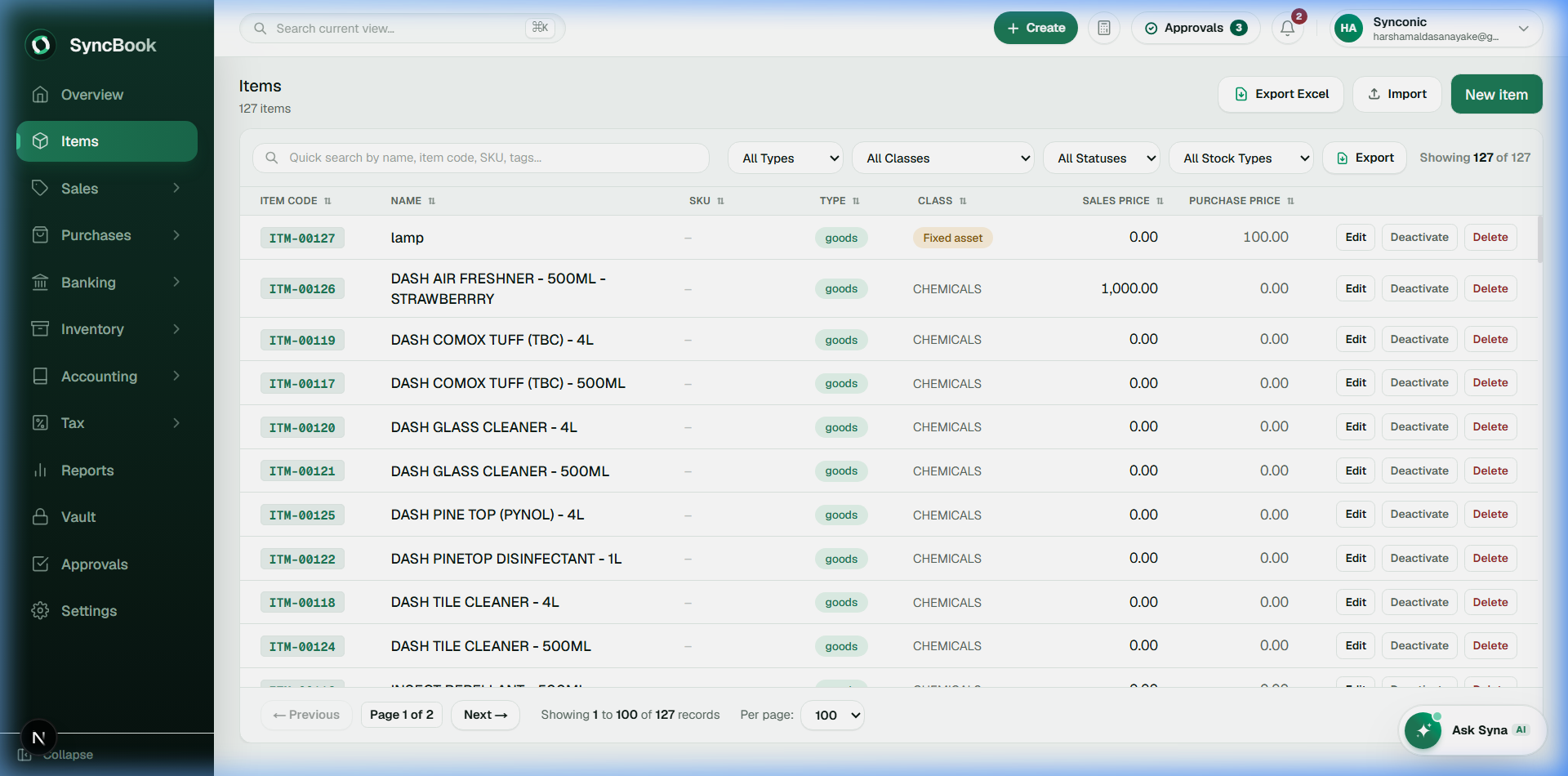
Delivered Submodules & Capabilities
In depth breakdown of the 8 native components forming the Inventory & Warehousing workspace:
Stock on hand
Live inventory dashboard displaying available, committed, and incoming stock across all SKU lines. Provides perpetual valuation balances based on LKAS 2 FIFO and weighted average costing methodologies.
- ✓Real time perpetual stock balances by SKU and location
- ✓FIFO and weighted average inventory valuation
- ✓Batch number and expiry date lifecycle tracking
- ✓Serial number tracking from receipt to dispatch
Item orders
Automated replenishment engine that identifies low-stock items approaching minimum safety thresholds. Generates draft purchase requisitions to prevent stockouts across retail shelves.
- ✓Minimum safety stock and reorder point monitoring
- ✓Automated purchase order requisition generation
- ✓lead time replenishment forecasting
- ✓Seasonal demand buffer recommendations
Warehouses
Configures multiple physical facilities including central distribution centers, branch stockrooms, transit hubs, and quarantine bays. Tracks individual bin and rack allocations.
- ✓multi warehouse hierarchy and regional branch mapping
- ✓Aisle, rack, and bin location tracking
- ✓Quarantine storage for damaged or inspection items
- ✓Location-specific inventory valuation reports
Goods received
Formal warehouse receiving procedure documenting inbound shipments from suppliers. Confirms delivered quantities, notes damaged packaging, and updates stock balances immediately.
- ✓Physical receiving inspection and quality verification
- ✓Automated inventory asset ledger posting
- ✓Landed cost allocation (freight, duty, clearance)
- ✓GRN printing with barcode labels for bin put away
Adjustments
Records physical inventory audit adjustments resulting from stock counts, damage, expiration, or shrinkage. Automatically posts balancing entries (DR Stock write off Expense, CR Inventory Asset).
- ✓Physical count variance recording and cycle counting
- ✓Damage, spoilage, and theft write off logging
- ✓Automated COGS and inventory loss journal creation
- ✓Supervisor approval requirement for high-value write offs
Transfers
Controls inter branch and inter warehouse stock relocations. Manages the dispatch-to-receipt cycle with an in transit inventory state to prevent inventory disappearing between locations.
- ✓multi branch transfer documentation and gate passes
- ✓in transit inventory holding account tracking
- ✓Discrepancy resolution on inter warehouse receipts
- ✓Branch-to-branch transit cost logging
Analytics
Deep inventory intelligence tracking inventory turnover ratios, stock holding costs, dead stock accumulation, and GMROI (Gross Margin Return on Investment).
- ✓Inventory turnover ratio and days sales of inventory (DSI)
- ✓Aging analysis (0-30, 31-60, 61-90, 90+ days)
- ✓slow moving and dead stock identification
- ✓Gross Margin Return on Investment (GMROI) reporting
Order analytics
Tracks fulfillment efficiency, analyzing supplier delivery lead times, order fill rates, and customer back order frequency to optimize procurement scheduling.
- ✓Supplier fulfillment accuracy and delivery punctuality
- ✓Order fill rate and back order frequency metrics
- ✓Warehouse dispatch processing turnaround times
- ✓Stockout frequency analysis per sales region
Core Capabilities & Accounting Logic
Perpetual Valuation Under LKAS 2
Every inventory transaction writes atomic accounting entries, ensuring your balance sheet stock asset matches physical warehouse value.
- Supports both FIFO and Weighted Average cost methods
- Automates Landed Cost distribution over imported shipments
- Eliminates painful manual year end inventory revaluations
multi location in transit Control
Move inventory securely between distribution centers and retail stores with dedicated in transit holding ledgers.
- Generates statutory transport dispatch notes and gate passes
- Detects transit shrinkage between dispatch and destination check-in
- Enables Real time cross branch stock availability lookups
Sri Lanka Statutory & Accounting Standards
Standardized valuation at the lower of cost and net realizable value.
Capitalization of customs duties, port charges, and freight into stock cost.
Standard Reports Generated
| Report Name | Frequency | Description |
|---|---|---|
| Inventory Valuation Summary | Real time | Perpetual valuation of all items across warehouses per LKAS 2. |
| Stock Movement Ledger | On demand | Chronological audit trail of receipts, issues, and adjustments per SKU. |
| Stock Aging Schedule | Monthly | Inventory age distribution highlighting slow moving assets. |
Accurate Landed Cost Allocation for Sri Lankan Importers
Sri Lankan commercial importers face substantial ancillary importation charges, including customs import duties, PAL (Port and Airport Development Levy), CESS, shipping line demurrage, and clearance fees.
Under LKAS 2, these costs must be capitalized into inventory rather than expensed immediately. SyncBooks Landed Cost engine allocates these costs proportionally across shipment lines by value, weight, or volume, ensuring true unit gross margin accuracy.
Frequently Asked Questions
Can SyncBooks track stock across multiple physical warehouses?↓
Yes. You can manage unlimited central warehouses, regional distribution centers, and retail store locations, with Real time transfer tracking between them.