
Table of Contents (11 Sections)↓
1. What Is Accounting Software?
Accounting software is a digital system that helps a business record, organize and manage its financial transactions.
Instead of maintaining financial information across spreadsheets, paper documents and separate systems, accounting software brings core financial activities into one connected environment, including:
For a growing business, the value of accounting software is not simply replacing a spreadsheet. It is creating a reliable financial system that connects everyday transactions with the financial information management needs to make decisions.
2. Why Are Businesses in Sri Lanka Moving to Accounting Software?
Many businesses start with spreadsheets because they are inexpensive and familiar.
As the business grows, however, financial information becomes more difficult to manage across hundreds or thousands of transactions involving customers, suppliers, banks, employees, inventory, and statutory taxes.
When this information is maintained manually, it becomes difficult to determine which figures are current and which records need attention.
Accounting software provides a structured way to record these transactions and connect them to the company's financial records. The goal is simple: Enter financial information once and make that information useful throughout the business.
3. What Should Accounting Software Do for a Sri Lankan Business?
While no single system fits every company identically, a useful accounting platform should cover the fundamental financial workflows of your organization:
Deep dive into SyncBooks's Sales, Purchases, Banking, Tax, and General Ledger workspaces.
4. Accounting Software and Sri Lankan Tax Compliance
Tax compliance is an important consideration for businesses operating in Sri Lanka. The Inland Revenue Department (IRD) provides requirements and guidance relating to VAT registration, tax invoices, accounting records, payments, and statutory returns.
The current IRD VAT guidance sets the standard VAT rate at 18%, alongside SSCL (2.5%) and Withholding Tax (WHT) schedules. Furthermore, the IRD requires online electronic submission of VAT returns via the RAMIS portal.
Accounting software helps businesses organize transaction data required for tax processes automatically, reducing audit risks and filing delays.
Read our detailed guide on VAT accounting, input credits, and issuing IRD-compliant tax invoices in Sri Lanka.
5. What Is Cloud Accounting?
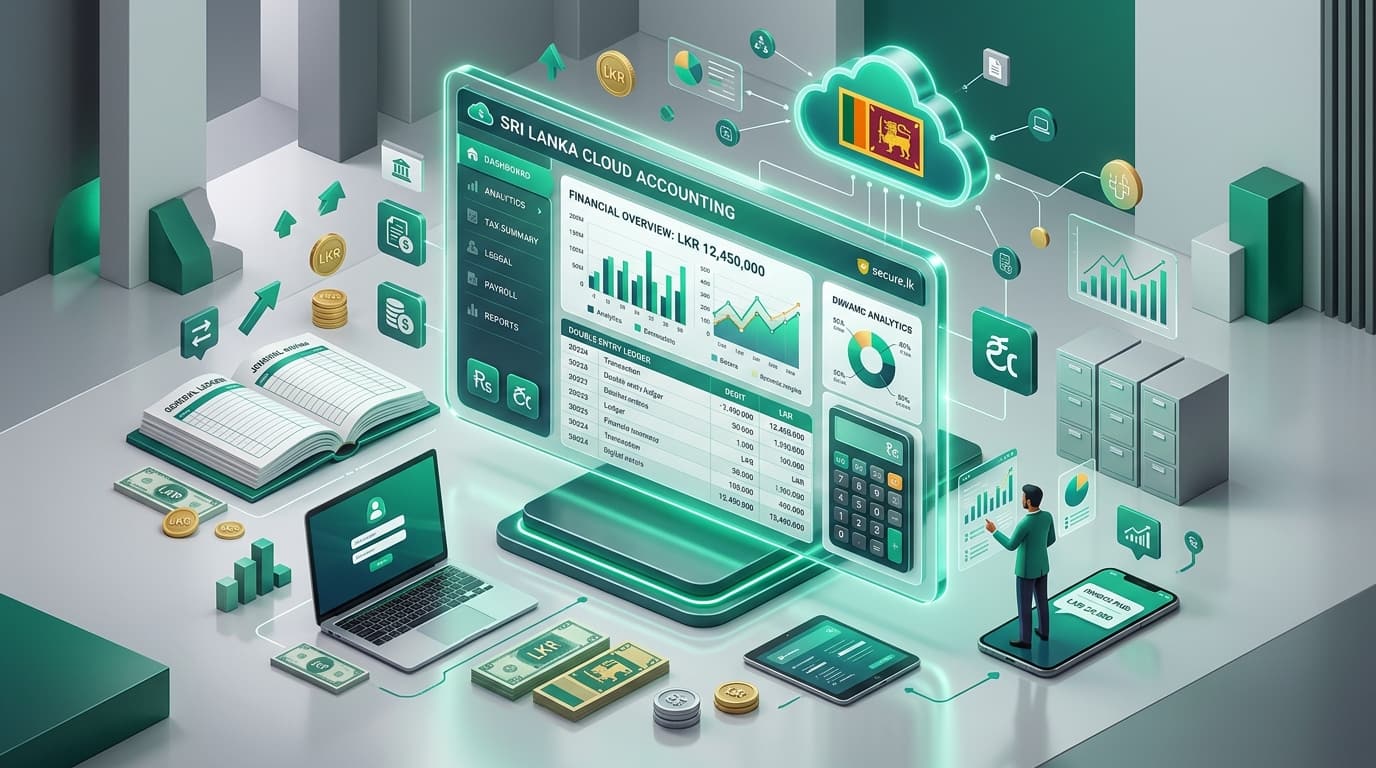
Cloud accounting refers to software hosted on secure, internet-connected infrastructure rather than installed locally on a single desktop computer.
A web-based platform allows authorized directors, accountants, and finance officers to collaborate from any browser with real-time data synchronization.
The real benefit is not just that the software is 'online'—it is having a centralized, single source of financial truth accessible anywhere.
6. What Makes Good Accounting Software Different?
Choosing software should not be based purely on the number of features listed on a website. Businesses must consider how well the system connects their actual workflows:
When these processes are seamlessly connected, accounting becomes an automatic byproduct of daily operations rather than an agonizing manual task at month-end.
7. Why Spreadsheets Eventually Become Difficult to Manage
Spreadsheets are flexible and inexpensive to start with, but as transaction volumes grow, several problems inevitably appear:
A growing enterprise eventually needs a system engineered specifically around connected financial workflows.
8. How SyncBooks Approaches Business Accounting
SyncBooks is a web-based double-entry accounting platform from SYNCONIC engineered around connected business and financial workflows for Sri Lankan companies.
Instead of treating accounting as an isolated ledger, SyncBooks unifies sales, purchases, banking, inventory, IRD tax returns, and general ledger records under one roof.
SyncBooks also introduces Syna AI, an embedded financial copilot that lets users query financial data naturally (e.g., 'What was our net margin this quarter?'), scans receipt photos via OCR, and flags uncharacteristic ledger anomalies in real time.
Discover how AI-driven anomaly detection and conversational finance simplify daily accounting.
9. Who Can Benefit From Accounting Software?
10. How to Choose Accounting Software in Sri Lanka
Before selecting an accounting platform, consider these 7 essential criteria:
1. Workflow Fit: Does it adapt naturally to how your team quotes, sells, and purchases?
2. Local Compliance: Does it natively support IRD tax invoices, VAT 18%, SSCL 2.5%, and WHT schedules?
3. Local Banking: Can it import statements from Sri Lankan commercial banks and track Post-Dated Cheques?
4. Scalability: Will it perform reliably as your transactions grow from 100 to 10,000+ per month?
5. Usability: Can everyday non-accountant team members create invoices and bills effortlessly?
6. Reporting Depth: Does it provide real-time Trial Balance, P&L, Balance Sheet, and aged debtor reports?
7. Transparent LKR Pricing: Are subscription costs fixed in Sri Lankan Rupees without foreign currency risks?
Explore SyncBooks's permanent free tier and feature-packed plans for Sri Lankan businesses.
11. Frequently Asked Questions
What is accounting software?
Accounting software is a digital system used to record, organize, and manage financial transactions and accounting information in one centralized environment.
Is accounting software useful for small businesses?
Yes. Small businesses can use accounting software to establish organized processes for invoices, expenses, payments, customers, suppliers, and financial reporting.
What should accounting software include?
Core capabilities commonly include invoicing, purchases, expenses, accounts receivable, accounts payable, general ledger, banking, reconciliation, and financial reporting, along with inventory and tax modules.
Is cloud accounting better than spreadsheets?
For growing businesses with increasing transaction volumes, cloud accounting provides superior security, multi-user collaboration, automated reconciliations, and instant financial reports that spreadsheets cannot match.
Can accounting software help with Sri Lankan VAT?
Yes. Modern software automatically computes 18% VAT and exports statutory schedules for the IRD RAMIS portal, though it should be used alongside qualified professional advice.
What is SyncBooks?
SyncBooks is a web-based double-entry accounting platform from SYNCONIC designed to connect everyday business workflows with Sri Lankan tax compliance, local banking, and Syna AI copilot intelligence.
📌Key Takeaway & Summary
Accounting software is no longer simply a digital replacement for a paper ledger. For a growing Sri Lankan business, it is the operational engine that connects sales, purchases, expenses, banking, inventory, and statutory compliance. SyncBooks is built around that exact vision: bringing business operations and accounting closer together in one connected web-based platform.
Published by the SyncBooks Knowledge & Research Team — Sri Lanka Accounting Cloud.