
← Back to Knowledge CenterTax & Compliance/11 min read

VAT Accounting in Sri Lanka: Rates, Input Tax Credit & IRD Filing Guide

Everything finance managers and business owners need to know about Value Added Tax (VAT 18%) compliance, input tax credits, SVAT and RAMIS portal returns.

SB
SyncBooks Editorial Team
Accounting & Tax Compliance Research • Updated 2026-09-04
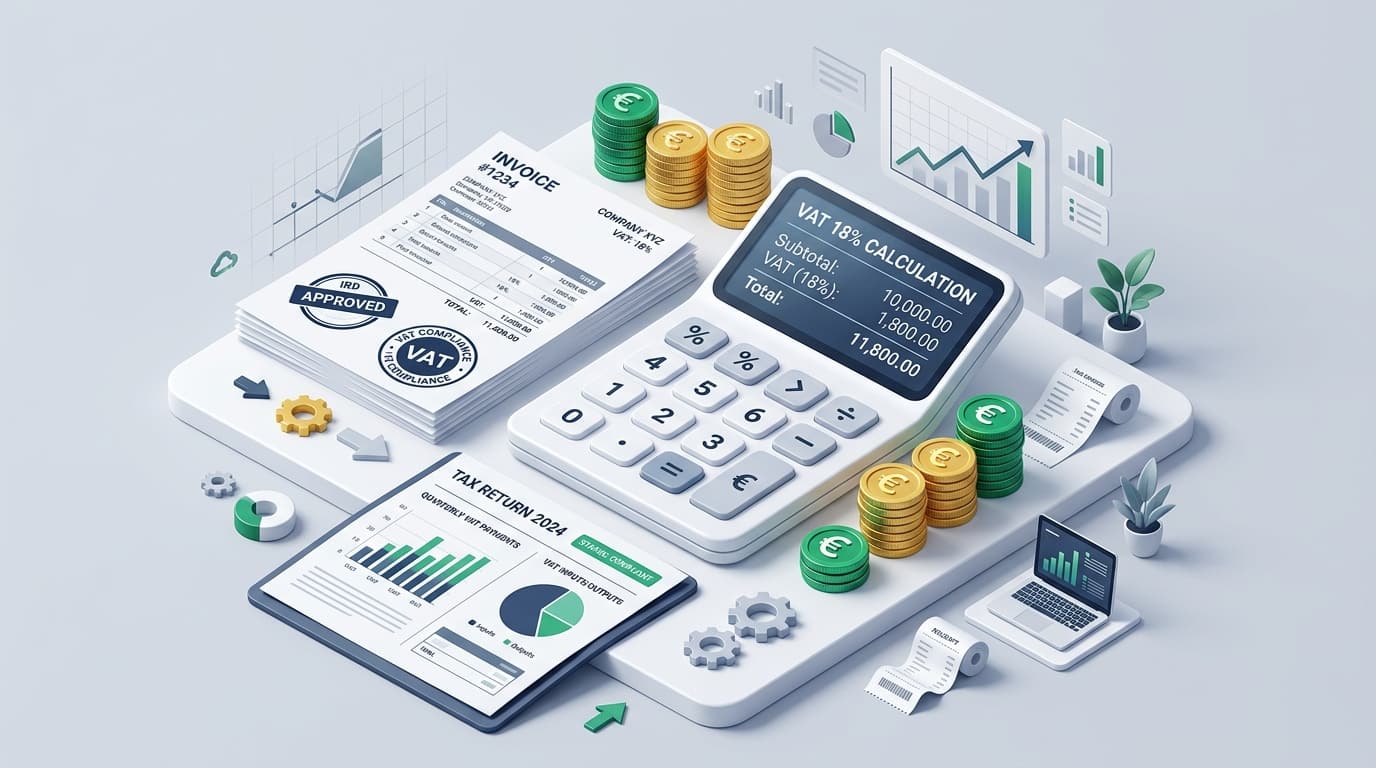
Sri Lanka VAT 18 Percent Tax Calculation & IRD Compliance Guide
Value Added Tax (VAT) is the primary indirect tax governing commercial transactions across Sri Lanka. Following recent fiscal reforms enacted under the Value Added Tax Act No. 14 of 2002 (as amended), the standard VAT rate stands at 18%, applicable across almost all standard goods and services. For Sri Lankan finance teams and business owners, managing VAT is not merely an annual tax calculation—it is a continuous operational workflow spanning customer invoicing, vendor bill verification, input tax credit apportionment, and electronic filing on the Inland Revenue Department (IRD) RAMIS portal.
Table of Contents (10 Sections)↓

1. VAT Legislation & Current Rates in Sri Lanka

Value Added Tax (VAT) in Sri Lanka is a multi-stage consumption tax levied on the value added at each step of the production and distribution chain.

Under the statutory framework administered by the Inland Revenue Department (IRD):

Standard Rate (18%): Levied on the supply of all taxable goods manufactured, imported, or distributed, as well as taxable services provided in Sri Lanka.
Zero-Rated Supplies (0%): Primarily applies to exported goods, services provided to overseas clients where payment is remitted in foreign currency through a licensed commercial bank, and international freight transport. Businesses supplying zero-rated goods can recover all underlying input VAT paid on their operational purchases.
Exempt Supplies: Certain essential commodities, public healthcare, educational services, and financial intermediation services are exempt from VAT. Unlike zero-rated supplies, providers of exempt supplies cannot claim input tax credits for expenses incurred in generating exempt revenue.

2. VAT Registration Thresholds & Mandatory Categories

Under current IRD statutory provisions, businesses operating in Sri Lanka must register for VAT when their taxable turnover meets or exceeds specific statutory thresholds:

Standard Threshold: Annual taxable supply turnover exceeding LKR 60,000,000 (or LKR 15,000,000 per taxable quarter).
Wholesale & Retail Businesses: Separate turnover provisions apply for commercial distributors, retail chains, and supermarkets exceeding prescribed thresholds.
Voluntary Registration: Businesses operating below the threshold may apply for voluntary VAT registration to enable input tax credit recovery, provided they satisfy IRD compliance requirements.

Once registered, the business is assigned an official Taxpayer Identification Number (TIN) and a VAT Registration Certificate, legally authorizing them to collect Output VAT and issue statutory Tax Invoices.

3. Output VAT vs. Input VAT Accounting Treatment

Proper double-entry accounting requires separating VAT from underlying operational revenues and expenses into balance sheet liability and asset sub-accounts:

Output VAT (Current Liability): The tax charged to customers on sales invoices. It does not belong to the business; it is collected on behalf of the Government of Sri Lanka.
Output VAT Entry: Debit Accounts Receivable (Gross), Credit Sales Revenue (Net), Credit Output VAT Payable (18%).
Input VAT (Current Asset): The tax paid by the business on commercial purchases, raw materials, electricity bills, and professional services.
Input VAT Entry: Debit Expense / Inventory (Net), Debit Input VAT Receivable (18%), Credit Accounts Payable (Gross).
Net VAT Settlement: At the end of each taxable period, the tax liability is offset: Net Payable = Output VAT - Allowable Input VAT. If Output VAT exceeds Input VAT, the net balance is remitted to the IRD. If Input VAT exceeds Output VAT, the credit balance is carried forward or claimed as a refund.

4. Input Tax Credit (ITC) Rules & Non-Deductible Restrictions

Under Section 22 of the VAT Act, claiming Input Tax Credits is subject to strict statutory rules and documentation standards:

Valid Tax Invoice Mandatory: Input tax can only be claimed if supported by an original, valid Tax Invoice issued by an IRD-registered supplier containing their TIN, sequential serial number, and your business details.
12-Month Claim Window: Input VAT must be claimed within 12 months from the end of the taxable period in which the tax invoice was issued.
Non-Deductible Input VAT: The IRD strictly disallows input tax credits on certain expenses, including passenger motor vehicles (purchases, hires, or leases), fuel costs, employee entertainment, staff welfare, and goods/services used for personal or non-business purposes.
Apportionment for Mixed Supplies: If a business produces both taxable (18%) and exempt supplies, input VAT incurred on shared overheads (e.g. office rent, software, utilities) must be apportioned according to the statutory turnover ratio.

5. The Simplified VAT (SVAT) Framework

The Simplified VAT (SVAT) scheme is a special administrative mechanism introduced by the IRD to eliminate cash flow bottlenecks for registered exporters and high-volume supply chains.

Under SVAT:

Registered Identified Persons (RIPs): Exporters and qualified manufacturers authorized to purchase goods and services without paying upfront cash VAT.
Registered Identified Suppliers (RISs): Vendors registered to supply goods or services to RIPs under suspended VAT.
SVAT Vouchers (Form SVAT 04 / 05): Instead of making physical cash VAT payments, the buyer issues an official SVAT Credit Voucher. The seller records the supply as a 'Suspended Tax Invoice' and uses the voucher to discharge their output tax liability in their RAMIS return.
⚡Tax Invoice Master Checklist

Review the exact 8 statutory fields required by the IRD for valid Tax Invoices and Suspended Invoices.

6. Interaction Between VAT (18%), SSCL (2.5%) & WHT

Sri Lankan businesses frequently face confusion regarding how VAT interacts with Social Security Contribution Levy (SSCL) and Withholding Tax (WHT):

SSCL (2.5%): Levied on the turnover of importers, manufacturers, and service providers. Under current tax guidelines, SSCL is calculated on the net invoice value (or 85% for retail/wholesale), and VAT (18%) is then computed on the combined value (Base Amount + SSCL).
Withholding Tax (WHT / AIT): Deducted at source on specified payments (e.g., rent, technical fees, service contracts exceeding threshold limits). WHT is calculated on the base value excluding VAT.

Using automated accounting software prevents calculation stacking errors and ensures that tax lines are correctly allocated to their respective IRD general ledger accounts.

7. IRD Filing Deadlines & RAMIS Online Submission

The Inland Revenue Department mandates strict compliance schedules for VAT payments and return filings:

Monthly Tax Payment: Due on or before the 20th day of the month following the end of each taxable period (e.g., January VAT payment is due by February 20th).
Quarterly Return Filing: The comprehensive VAT return, along with electronic schedules for Sales (Schedule 1), Purchases (Schedule 2), and SVAT (Schedules 4 & 5), must be uploaded to the IRD RAMIS online portal on or before the last day of the month following the end of the taxable quarter.
Penalties: Late payments incur statutory penalties of 10% on the outstanding amount, plus an additional 2% compounding interest per month of default.

8. Common VAT Accounting Mistakes & Audit Hazards

During IRD tax audits, officials frequently issue assessments and penalties for the following operational oversights:

1. Claiming Input VAT on Non-Compliant Invoices: Accepting commercial bills or invoices missing mandatory buyer TINs or tax breakdowns.

2. Claiming Input Tax on Passenger Vehicles: Attempting to claim VAT on company vehicle purchases or leases disallowed under Section 22.

3. Mismatch with RAMIS Supplier Uploads: Claiming input credits where the supplier failed to declare the matching output invoice in their RAMIS return.

4. Failure to Apportion Mixed Supplies: Claiming 100% input credits on shared company overheads when a portion of revenue is VAT-exempt.

5. Incorrect Credit Note Adjustments: Adjusting VAT for returned goods without issuing statutory Credit Notes cross-referencing the original Tax Invoice.

9. How Modern Accounting Software Automates IRD Compliance

Managing VAT across thousands of transactions using spreadsheets inevitably creates formula errors, missed credit claims, and filing stress.

SyncBooks provides an integrated Sri Lankan Tax Engine that:

Automatically applies 18% VAT and 2.5% SSCL on sales and purchase transactions.
Validates supplier TINs and enforces IRD-compliant tax invoice formatting.
Separates input tax into deductible, non-deductible, and capital asset sub-ledgers automatically.
Exports ready-to-upload RAMIS CSV schedules for instant quarterly filing.
Uses Syna AI to flag uncharacteristic tax entries and missing invoice references before month-end closing.
⚡Automate Your Sri Lanka VAT

See how SyncBooks automates VAT 18%, SSCL, WHT schedules, and RAMIS returns.

10. Frequently Asked Questions

What is the current standard VAT rate in Sri Lanka?

The standard VAT rate is 18%, applicable on taxable supplies of goods and services and imports into Sri Lanka.

Can my business claim VAT on everyday company expenses?

Yes, provided the expense is incurred strictly for business operations, the supplier is VAT-registered, and you receive an official Tax Invoice with your business TIN. Non-deductible expenses like passenger vehicles, fuel, and staff entertainment cannot be claimed.

What happens if our Input VAT exceeds Output VAT?

When Input VAT exceeds Output VAT, the excess credit is generally carried forward to offset future taxable periods. Exporters and specific qualifying entities may apply to the IRD for cash refunds.

What is the deadline for filing VAT returns on RAMIS?

VAT returns must be submitted electronically via the IRD RAMIS portal on or before the last day of the month following the end of each taxable period (e.g. Q1 return is due by April 30th).

Can an unregistered business charge VAT?

No. It is illegal under the VAT Act for an unregistered person to collect VAT or issue documents titled 'Tax Invoice'. Offenses carry severe financial penalties and legal liability.

How does SyncBooks help with RAMIS electronic filing?

SyncBooks automatically compiles your sales and purchase records into the exact multi-column CSV format required by the IRD RAMIS portal, allowing you to upload statutory schedules without manual data entry.

📌Key Takeaway & Summary

Mastering VAT accounting in Sri Lanka requires strict documentation, accurate double-entry record keeping, and proactive tax ledger reconciliation. By implementing modern cloud accounting software tailored for IRD statutory standards, finance teams can protect cash flow, maximize allowable input tax credits, and eliminate compliance friction.

SB
SyncBooks Editorial Team
Accounting & Tax Compliance Research

Published by the SyncBooks Knowledge & Research Team — Sri Lanka Accounting Cloud.