
Table of Contents (10 Sections)↓
1. Why Bank Reconciliation is the Foundation of True Financial Accuracy
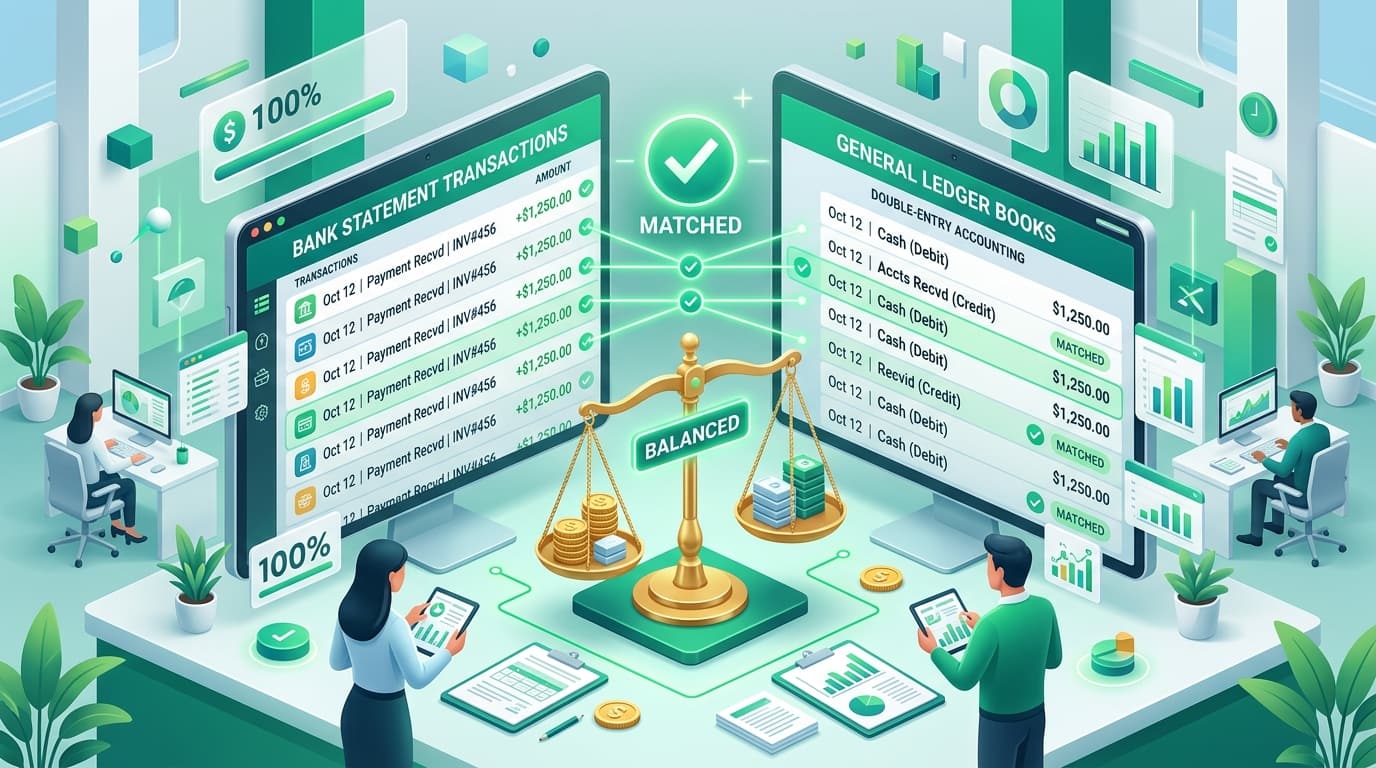
Your General Ledger bank account and your physical bank account will almost never match at any single point in time without formal reconciliation due to natural timing differences, direct bank debits, and processing lags.
The 4 Core Objectives of Bank Reconciliation:
2. The Sri Lankan Commercial Banking Landscape & Statement Formats
Most Sri Lankan businesses maintain corporate operating accounts across major domestic commercial banks:
Modern accounting systems must flexibly parse these varied CSV/XLS structures without manual data manipulation.
3. Common Timing Differences & Local Discrepancies
When comparing your General Ledger against bank statements, discrepancies fall into two categories:
1. Timing Differences (No Ledger Adjustment Required):
2. Ledger Adjusting Items (Must Be Posted to the Ledger):
4. Accounting for Bank Charges, Stamp Duties & CEFT Fees
Sri Lankan bank statements contain specific local transaction costs that must be properly journalized during reconciliation:
5. Reconciling Post-Dated Cheques (PDCs) Without Cash Flow Distortion
A critical pitfall in Sri Lankan accounting is recording received Post-Dated Cheques directly into the main bank asset ledger account before their maturity date. Doing so artificially inflates book cash balances and makes bank reconciliation impossible.
The Proper Accounting Standard:
1. When PDC is received: Record in a PDC In-Hand Clearing Account (Current Asset). The main bank ledger is untouched.
2. When PDC reaches maturity and is deposited: Record a transfer journal from PDC In-Hand → PDC in Clearing.
3. When bank statement confirms clearance: Record the final credit to Commercial Bank Ledger Account.
This ensures your General Ledger bank account matches the real commercial bank statement on every reconciliation run.
6. Handling Dishonoured / Returned Cheques & Bank Penalties
When a customer cheque bounces (insufficient funds, signature mismatch, stale date):
1. The bank debits your account for the original deposit amount, plus a Cheque Return Charge (typically LKR 500 – LKR 1,500).
2. Double-Entry Correction:
3. Notify the customer and issue a formal demand note with an updated statement of account.
7. Step-by-Step 5-Stage Bank Reconciliation Procedure
Follow this standard 5-stage procedure at the end of each accounting period:
1. Extract Bank Statement: Download the official CSV/e-statement for the exact calendar period.
2. Match Inward Deposits: Compare recorded customer receipts and cash deposits against statement credits.
3. Match Outward Payments: Match vendor bill payments, direct transfers, and cleared cheques against statement debits.
4. Post Unrecorded Bank Items: Create and post adjusting journals for direct debits, CEFT fees, and standing orders.
5. Generate Bank Reconciliation Statement: Produce the formal report proving that `General Ledger Balance + Unpresented Cheques - Deposits in Transit = Bank Statement Closing Balance`.
8. Internal Controls, Segregation of Duties & Statutory Audits
To safeguard company assets, statutory auditors enforce strict internal control principles around bank reconciliation:
9. How SyncBooks Automates 95%+ of Commercial Bank Reconciliation
Manual bank reconciliation in spreadsheets is tedious, error-prone, and slow. SyncBooks transforms reconciliation into a rapid 2-minute workflow:
Explore SyncBooks's Banking workspace to upload statement CSVs, auto-match ledger lines, and manage PDCs seamlessly.
10. Frequently Asked Questions (FAQ)
How often should a Sri Lankan business perform bank reconciliation?
While monthly reconciliation is the statutory minimum for financial reporting, active trading, distribution, and retail businesses should reconcile bank accounts weekly or daily to catch failed transfers and prevent cash shortfalls.
What is an unpresented cheque?
An unpresented cheque is a cheque that your business has written and recorded in your ledger, but the payee has not yet deposited or the bank has not yet cleared.
How long is a commercial cheque valid in Sri Lanka?
Under Sri Lankan commercial banking law, a cheque is valid for 6 months from the date written on the cheque. After 6 months, it becomes a stale cheque and is dishonoured by banks.
What is the difference between CEFT and SLIPS transfers in Sri Lanka?
CEFT (Common Electronic Fund Transfer) is a real-time transfer system operating 24/7 with immediate credit (usually for amounts up to LKR 5 million). SLIPS (Sri Lanka Interbank Payment System) is a batch processing system settling within several hours or next business day.
Why does SyncBooks use a separate clearing account for Post-Dated Cheques?
Using a dedicated PDC clearing account ensures that post-dated cheques in hand are tracked as future assets without artificially inflating your real cash balance or creating reconciliation discrepancies.
📌Key Takeaway & Summary
Bank reconciliation is the ultimate safeguard of a company’s financial integrity. By integrating commercial bank statement imports and intelligent matching with SyncBooks, Sri Lankan finance teams eliminate reconciliation backlogs, safeguard cash flow, and ensure 100% audit-ready ledgers.
Published by the SyncBooks Knowledge & Research Team — Sri Lanka Accounting Cloud.